General info

Characteristics of the micro-climate on the island of Silba

The island of Silba is situated in the northern Adriatic. In order to estimate climatic conditions of this island the meteorological observations such as air temperature, precipitation, relative humidity, cloudiness, wind and occurrences of dew, fog, hail and thunder have been done by Meteorological and Hydrological Service, Zagreb, Croatia since 1964.

Click here for a downloadable (49kb) PDF version of a part of an article: Climatic condition in the marine park of Silba written by mr. sc. Visnja Vucetic and Marko Vucetic, dipl. ing. published in Croatian Meteorological Journal in 1997.

WIND REGIME
The wind regime on the Adriatic coast is one of the decisive factors affecting the landisland flora and fauna with its characteristic winds, known as bura, jugo and maestral blowing along the Adriatic coast.The most frequent wind on the island of Silba is the bura blowing from NE (14.5%), then the SE wind known as jugo (11.9%) and a NW wind (9.3%).
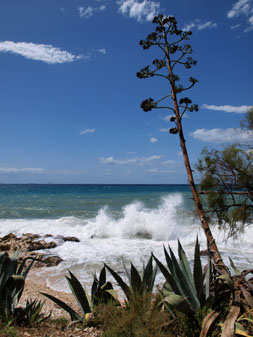
The bura is a dry, cold and gusty wind and intensifies the feeling of cold. A strong bura wind over the sea tears the crests of the waves and causes marine spray. The coast exposed to the bura is sprinkled with salt from evaporated seawater brought there by the bura with sea spray. Plants hardly grow on such areas and the soil is bare.
In contrast to the bura the jugo blows uniformly and causes high waves. In the southern wind regime warm air penetrates the Adriatic sea from North Africa adopting maritime characteristics and thus rain falls.
Closer to the mainland the maestral occurs in summer. The etesian winds (seasonal winds from the NW direction) superpone with the sea breeze (a day wind from the same direction in accordance with coastal circulation) and the maestral occurs. The maestral is refreshing in summer and is always followed by bright and dry weather.

AIR TEMPERATURES
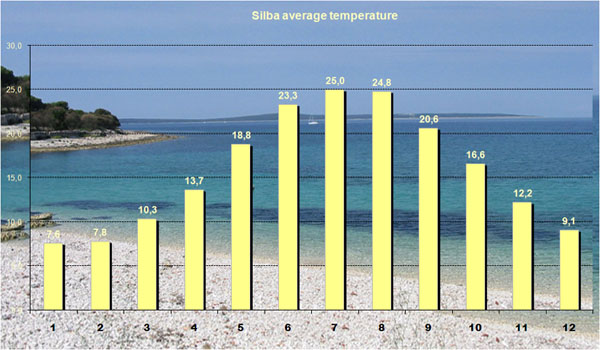
Standard temperature measurements are taken at 2 m above the ground, where the daily temperature fluctuation of air is smaller. Temperature conditions on Silba have been analysed showing the annual course of air temperature resembles a simple wave with its lowest temperature in January and its highest in July. The mean annual air temperature is 15.1°C . The maximum number of days with air temperature above 30°C (hot days) occurred from June to September (16.8 days in average) and most of them were in August. A warm night is a day when the minimum daily temperature exceeds 20°C. In July and August this is a very frequent phenomenon on the Adriatic coast and also on Silba (32.8 days in average).

climate

AIR HUMIDITY
Relative air humidity has an annual course opposite to that of air temperature. In average, a maximum relative humidity occurs in January (76%) and a minimum in July (68%), which indicates that the air is relatively rich with humidity on Silba. Such annual courses of relative humidity are characteristic for the maritime climate where the difference between the maximum and minimum mean monthly relative humidity is usually small.

PRECIPITATION CONDITIONS
The annual course of precipitation at Silba can be defined as maritime. A minimum precipitation falls in July (37.6 mm) and a maximum in November (127.7 mm). In summer, the cyclone paths are further to the north, the Adriatic is under the influence of the Azores anticyclone, which causes a minimum amount of precipitation, and a maximum number of clear days (about 15 days per month). In the 30-year period the maximum daily precipitation amount was 144.7 mm.
The meteorological phenomena, which mostly influence the land and island flora, are dew, fog and hail, which are often connected with thunderstorms. Dew covering the soil, can be of great importance for the plants on the Adriatic islands during the dry season. In some areas, it appears in quite a large amount and it may be the only source of humidity for plants. On Silba thunder (37.8 days in average), fog (7.0 days) and hail (1.8 days) are neither very frequent nor very rare phenomena, but dew is frequent (86.3 days in average).